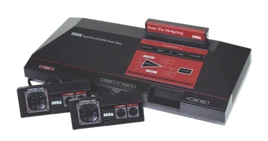


Serving Up a Classic: The Origins of Sega's Great Tennis
Released during the formative years of console sports gaming, Great Tennis (Japan) stands as one of Sega's earliest attempts to bring the excitement of professional tennis into the living room. Developed and published by Sega for the Master System Mark III in 1985, the game arrived at a time when sports simulations were still finding their identity. While modern players are accustomed to motion-captured athletes and photorealistic courts, Great Tennis demonstrated how clever design and responsive gameplay could capture the essence of a sport using only a handful of sprites and limited hardware resources.
As one of the flagship sports titles in Sega's growing "Great" series—which included Great Soccer, Great Golf, and Great Baseball—the game helped establish the Master System as a serious alternative to competing home consoles. More importantly, it proved that tennis could be translated effectively into an engaging video game format long before the genre became crowded with major franchises.
Great Tennis (Japan): A Pioneer of Digital Court Competition
When Great Tennis launched in Japan, tennis games were still relatively uncommon on home consoles. Arcade sports titles existed, but most lacked the strategic depth required to simulate an actual tennis match. Sega approached the challenge by focusing on fundamentals: positioning, timing, shot placement, and player movement.
The result was a surprisingly authentic tennis experience for the mid-1980s. Rather than overwhelming players with complexity, Great Tennis distilled the sport into a form that was easy to learn yet difficult to master.
This philosophy would influence many later tennis games, including titles that appeared on the Mega Drive, Saturn, Dreamcast, and beyond.
Mastering the Court: Gameplay Mechanics That Reward Skill
Simple Controls, Deep Strategy
At first glance, Great Tennis appears straightforward. Players move around the court using the directional pad and hit the ball using a single action button. However, beneath this simple interface lies a surprising amount of depth.
Winning matches requires mastering several key skills:
- Positioning yourself correctly before each return.
- Timing shots for maximum effectiveness.
- Anticipating your opponent's movements.
- Controlling rally pace through shot placement.
- Balancing aggressive attacks with defensive play.
Unlike many early sports games that rely heavily on luck, Great Tennis rewards precision and consistency. A poorly timed swing can send the ball directly into the net or out of bounds.
Fast-Paced Rally Exchanges
The game's most compelling moments occur during extended rallies. As the ball accelerates across the court, players must react quickly while maintaining proper positioning.
These exchanges create a sense of tension that remains enjoyable even decades later. The challenge comes not from memorizing patterns but from developing strong reflexes and court awareness.
Computer Opponents That Fight Back
For an early Master System title, the artificial intelligence performs admirably. Opponents react to player actions, forcing competitors to vary their strategy rather than relying on a single winning tactic.
This helps maintain replay value and encourages long-term mastery.
Technical Excellence on 8-Bit Hardware
Creating a convincing tennis game on the Master System Mark III required careful optimization. Every frame of animation and every movement calculation had to operate within strict hardware limitations.
Clear Visual Design
The game's overhead perspective provides excellent visibility of the court. Players can easily track the ball's trajectory while positioning themselves for returns.
Although occasional sprite flickering appears during intense exchanges, Sega successfully maintained clarity throughout matches. This was particularly important in a sport where split-second reactions determine victory.
Smooth Animation and Responsiveness
One of Great Tennis's biggest strengths is its responsiveness. The controls feel immediate, with minimal perceived input lag. This responsiveness is essential because successful gameplay depends heavily on timing.
Player animations are limited compared to modern standards, yet they effectively communicate movement and shot execution.
Sound Design and Match Atmosphere
The Master System's PSG sound chip delivers simple but effective audio. Ball impacts, player movements, and menu sounds provide valuable feedback, while the music helps establish the competitive atmosphere.
Although modest compared to later console generations, the sound design contributes significantly to the overall experience.
Playing Great Tennis Today Through Emulation
Modern emulation has made preserving and enjoying Great Tennis easier than ever. Thanks to accurate Master System emulators, players can experience the game exactly as it was originally intended while benefiting from modern enhancements.
Recommended Emulators
- Genesis Plus GX
- RetroArch (Genesis Plus GX Core)
- MEKA
- Ares
- BizHawk
These emulators provide excellent compatibility and faithfully reproduce Master System hardware behavior.
Best Emulator Settings
- Enable accurate timing mode.
- Use integer scaling for clean pixels.
- Activate save states for practice sessions.
- Disable aggressive smoothing filters.
- Use low-latency audio settings.
- Apply CRT shaders for an authentic 1980s presentation.
When rendered at 4K resolution, Great Tennis looks remarkably sharp. The simple sprite artwork benefits from modern scaling techniques, while CRT filters can recreate the appearance of an original television display.
On handheld devices such as the Steam Deck, Ayn Odin, Retroid Pocket, and other Android-based systems, the game runs flawlessly while consuming minimal battery power.
Common Emulation Issues
If gameplay feels too fast or too slow, verify that your emulator is configured for the correct Master System refresh rate. Audio synchronization problems can typically be fixed by updating emulator cores or adjusting audio latency settings.
Using verified ROM dumps is also recommended to ensure compatibility and accurate preservation.
The Legacy of Sega's Early Tennis Champion
While Great Tennis may not receive the same recognition as later sports franchises, its importance within Sega's history is undeniable. The game helped establish the company's reputation for quality sports titles and demonstrated that tennis could succeed on home consoles.
Many concepts introduced here—timing-based gameplay, strategic positioning, and accessible controls—would continue to influence sports game design for years to come.
Today, retro gaming communities appreciate Great Tennis not only as an enjoyable sports title but also as a significant milestone in the evolution of digital tennis simulations. Collectors continue to seek original cartridges, while preservationists ensure the game's legacy remains intact for future generations.
Frequently Asked Questions
What is the best way to play Great Tennis (Japan) today?
RetroArch with the Genesis Plus GX core offers excellent compatibility, save states, controller customization, and support for modern displays.
How do I fix graphical glitches in Great Tennis (Japan)?
Use an accurate emulator and ensure you are using a verified ROM dump. Most visual issues result from incorrect emulator settings rather than the game itself.
Does Great Tennis support multiplayer?
Yes. The game was designed with competitive play in mind and remains particularly enjoyable when played against another person.
Is Great Tennis still worth playing today?
Absolutely. Its responsive controls, accessible mechanics, and historical significance make it one of the most enjoyable early sports titles available on the Master System Mark III.


