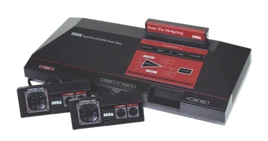


Entering the Digital Arena: Pit-Fighter on the Master System
When players talk about controversial and groundbreaking fighting games of the early 1990s, Pit-Fighter (Europe) often enters the conversation. Originally developed by Atari Games and released in arcades in 1990, Pit-Fighter was one of the earliest fighting games to use digitized actors instead of traditional hand-drawn sprites. The Master System adaptation brought this brutal underground combat experience into living rooms across Europe, giving Sega owners a chance to experience one of arcade gaming's most talked-about spectacles.
At a time when one-on-one fighting games were still finding their identity, Pit-Fighter stood apart through its gritty presentation, unconventional combat mechanics, and tournament-style progression. While later giants would dominate the genre, this game remains an important historical artifact that showcases the industry's experimentation before the fighting game boom truly exploded.
Pit-Fighter (Europe): A Bold Arcade Conversion
The original arcade release gained attention because of its digitized graphics, a technology that captured real actors and converted them into in-game sprites. This visual style would later become famous through games like Mortal Kombat, but Pit-Fighter arrived first.
The European Master System version faced an enormous challenge. Sega's 8-bit hardware was significantly less powerful than the arcade board, forcing developers to redesign visual assets while preserving the game's identity. The result was a scaled-down yet recognizable adaptation that maintained the core concept of brutal arena combat.
Players could choose between three fighters:
- Buzz – A powerful brawler with devastating strength.
- Ty – A balanced fighter suitable for newcomers.
- Kato – A fast martial artist specializing in agility.
Each character offered distinct strengths, encouraging experimentation and replayability.
Mastering the Underground Arena
More Than a Traditional Fighting Game
Unlike modern fighting games that rely on complex combo systems, Pit-Fighter focuses on raw aggression and environmental awareness. Matches take place in enclosed arenas surrounded by spectators who occasionally interfere with the action.
Victory isn't always about depleting an opponent's health. Players can throw enemies out of the ring, exploit arena hazards, and use weapons scattered around the stage.
This created a surprisingly chaotic experience compared to the more structured gameplay of contemporaries.
Environmental Combat
One of the game's most memorable features is its interactive arenas. Trash cans, barrels, and other objects can become improvised weapons. Opponents can be cornered, knocked into hazards, or launched into the crowd.
These mechanics introduced a layer of unpredictability rarely seen in fighting games of the era. Every arena demanded a slightly different strategy, making positioning almost as important as timing punches and kicks.
Tournament Progression
The game follows a tournament format where fighters battle increasingly difficult opponents. Success rewards players with prize money and advancement through the ranks.
As matches become tougher, enemy aggression increases significantly. Later opponents react faster and punish mistakes more effectively, creating a steep difficulty curve that many Master System owners still remember today.
Pushing the Master System Hardware
Converting a digitized arcade fighter to Sega's 8-bit console was no small task. The Master System's limited memory and processing power forced developers to make compromises, yet the game still managed to retain elements that made the arcade version unique.
Digitized Character Representation
Although the sprites were heavily reduced, the development team worked hard to preserve the recognizable appearance of the original fighters. The resulting visuals were impressive for the platform and demonstrated creative optimization techniques.
Players will notice occasional sprite flickering and reduced animation frames compared to the arcade version, but these compromises were common across ambitious Master System ports.
Sound and Atmosphere
The Master System's PSG audio chip delivered punchy sound effects that helped sell the impact of each hit. While it lacked the arcade cabinet's sampled speech and richer audio hardware, the soundtrack effectively maintained the game's gritty atmosphere.
Crowd noises, hit effects, and victory cues contributed to the feeling of participating in an underground fighting tournament.
Playing Pit-Fighter Today Through Emulation
Modern emulation offers the best way to revisit Pit-Fighter on contemporary hardware while preserving the authentic gameplay experience.
Recommended Emulators
- Genesis Plus GX – Excellent Master System compatibility and accuracy.
- Mesen – Modern interface with robust debugging and enhancement options.
- RetroArch – Flexible frontend supporting multiple Master System cores.
- Emulicious – Highly accurate and useful for preservation enthusiasts.
Optimal Settings
- Enable integer scaling for sharper pixel presentation.
- Use low-latency settings to minimize input lag.
- Activate save states for practicing difficult tournament sections.
- Apply CRT shaders to recreate the appearance of a 1990s television.
- Disable excessive smoothing filters to preserve pixel detail.
When upscaled to 4K, the game's sprite work becomes remarkably clean. Modern shaders can reduce jagged edges while preserving the authentic visual style. On portable devices such as the Steam Deck and Odin handhelds, Pit-Fighter runs flawlessly and benefits from responsive controls and improved display technology.
If you encounter visual glitches, ensure the emulator is configured specifically for Master System mode rather than Game Gear compatibility. Most modern emulators handle this automatically, but incorrect region settings can occasionally cause display issues.
The Legacy of an Early Fighting Pioneer
Pit-Fighter occupies a fascinating place in gaming history. It may not have achieved the long-term popularity of Street Fighter II or Mortal Kombat, but its influence is undeniable.
The game's use of digitized performers helped establish a visual trend that would dominate several fighting games throughout the 1990s. Its environmental interactions also foreshadowed mechanics later explored in numerous arena fighters and wrestling games.
Today, retro gaming enthusiasts appreciate Pit-Fighter as a snapshot of a transitional era. It represents developers experimenting with technology and game design before the genre settled into the conventions players now recognize.
Speedrunners occasionally revisit the title, searching for efficient routes through tournament brackets and exploiting AI behavior to achieve faster completion times. Preservation communities continue documenting regional versions, including the European Master System release, ensuring this unique fighter remains accessible for future generations.
Pit-Fighter (Europe) FAQ
What makes Pit-Fighter different from other early fighting games?
The game emphasizes environmental combat, ring-outs, and weapon usage rather than complex combo systems. Its digitized character graphics were also highly innovative for the period.
What is the best way to play Pit-Fighter today?
Accurate emulators such as Genesis Plus GX, Mesen, or RetroArch provide the most reliable experience while offering modern conveniences like save states and latency reduction.
Why does the Master System version look different from the arcade game?
The Master System had significantly less memory and processing power than Atari's arcade hardware, requiring smaller sprites, fewer animation frames, and simplified visual effects.
How can I reduce input lag when emulating Pit-Fighter?
Enable low-latency or run-ahead features where available, use wired controllers when possible, and avoid excessive post-processing filters that introduce additional frame buffer delay.
More than three decades after its release, Pit-Fighter remains an intriguing chapter in fighting game history. Its ambitious digitized visuals, chaotic arena battles, and unique approach to combat continue to make it a memorable experience for retro gaming enthusiasts exploring the Master System library.


