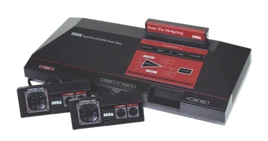


Retro Air Combat on the Master System: A Forgotten Arcade-Style Curiosity
Sky Fighter (Korea) (En) (Unl) is one of those elusive Master System Mark III curiosities that surfaced through Korea’s vibrant and often undocumented aftermarket scene. While its exact development origins remain partially obscured—typical of many unlicensed regional releases of the era—this aerial combat shooter stands as a fascinating example of how developers pushed Sega’s 8-bit hardware beyond its expected boundaries. Built around fast-paced shooting mechanics and arcade-inspired pacing, Sky Fighter (Korea) (En) (Unl) captures the raw spirit of early vertical shooters while embracing the limitations of its platform.
Released during a time when the Master System was already declining in mainstream Western markets but still thriving in Brazil and parts of Asia, the game reflects a transitional moment in gaming history. It is less a polished flagship title and more a passionate experiment: a compact, action-driven shooter designed to deliver immediate arcade gratification at home.
Striking the Skies: Sky Fighter (Korea) (En) (Unl) and Its Place in Master System History
The Master System Mark III library is known for its mix of official Sega releases and unlicensed regional cartridges, and Sky Fighter (Korea) (En) (Unl) fits firmly into the latter category. Its significance lies not in commercial success but in preservation value. It represents the Korean aftermarket scene’s tendency to rework familiar arcade concepts into cartridge-based experiences that could run on widely available hardware.
Unlike more structured Sega-published shooters, Sky Fighter embraces a stripped-down design philosophy: minimal narrative framing, immediate gameplay loops, and a focus on score attack. This makes it particularly interesting for historians studying how arcade design language was adapted for home consoles with strict memory and sprite limitations.
Arcade DNA in a Cartridge Shell
The game follows a classic vertical-scrolling shooter structure. Players pilot a jet fighter through increasingly dense waves of enemy aircraft, ground turrets, and patterned bullet spreads. The core loop is simple: survive, dodge, and destroy. However, the pacing gradually intensifies, forcing players to memorize enemy formations and refine movement precision.
- Vertical scrolling stages with increasing speed curves
- Predictable but dense enemy spawn patterns
- Occasional mid-stage difficulty spikes resembling arcade boss rush design
- Score-based progression emphasis rather than narrative advancement
This simplicity is deceptive. As the screen fills with overlapping sprites, the Master System’s hardware limitations begin to surface, producing occasional sprite flickering and tight collision windows that reward patience and pattern recognition.
Mastering the Airspace in Sky Fighter (Korea) (En) (Unl)
At its core, gameplay revolves around survival through precision movement. The player’s jet has a fixed firing pattern, meaning positioning is more important than offensive complexity. Unlike later shooters that introduced weapon upgrades or branching loadouts, Sky Fighter remains grounded in straightforward shooting mechanics.
Combat Rhythm and Difficulty Scaling
The game’s difficulty curve is gradual but unforgiving. Early stages introduce slow-moving enemies and simple bullet trajectories, but later levels escalate into tightly packed formations that require pixel-perfect dodging. Input responsiveness is generally solid, though some players may notice slight input lag depending on hardware or emulator configuration.
Boss encounters, while minimalistic in design, serve as endurance tests rather than spectacle pieces. They rely on repetitive attack cycles and weak-point exposure windows, demanding memorization rather than improvisation.
Visual and Audio Feedback
Graphically, Sky Fighter uses the Master System’s limited palette effectively, with high-contrast enemy sprites against darker scrolling backgrounds. However, hardware constraints result in occasional frame buffer stress, especially during high-action sequences.
The soundtrack follows typical 8-bit shooter conventions: looping, high-tempo melodies designed to maintain adrenaline rather than atmospheric depth. Sound effects—laser shots, explosions, and hit confirmations—are sharp but simple, reinforcing the arcade-like experience.
Technical Ambition Behind Sky Fighter (Korea) (En) (Unl)
Despite its unlicensed nature, the game demonstrates a surprising understanding of hardware optimization. The Master System’s VDP (Video Display Processor) is pushed close to its sprite handling limits during later stages, resulting in visible flicker when multiple projectiles overlap. This is not necessarily a flaw but rather evidence of aggressive sprite layering techniques used to simulate arcade density.
Tile reuse is heavily implemented to conserve memory, and background scrolling is smooth but minimalistic. There is no parallax layering, but careful palette cycling creates the illusion of depth in certain levels.
Audio processing remains stable, with no noticeable distortion even under heavy sprite load, suggesting efficient sound channel management despite limited resources.
Preserving Sky Fighter (Korea) (En) (Unl) in Modern Emulation
Today, preserving and playing Sky Fighter (Korea) (En) (Unl) is best achieved through accurate Master System Mark III emulation. Popular emulators such as Meka, BizHawk, and RetroArch’s SMS cores handle the game well, but some settings can significantly improve the experience.
Recommended Emulator Settings
- Enable “accurate VDP timing” to reduce sprite desync issues
- Set frame delay to 1–2 frames to minimize input lag
- Use integer scaling when playing in 1080p or 4K for crisp pixel output
- Disable rewind during heavy-action segments to avoid audio desynchronization
On modern handhelds like the Steam Deck or Android-based devices such as the Odin, the game runs flawlessly. The low system requirements allow for perfect battery efficiency, making it ideal for portable retro shooter sessions.
When upscaled to 4K with modern shaders, Sky Fighter gains a surprising amount of visual clarity. CRT filter presets help restore scanline authenticity, while pixel scaling shaders reduce the harsh edges caused by original low-resolution output.
Legacy of a Hidden Korean Shooter Experiment
While Sky Fighter never achieved mainstream recognition, it holds a niche but important place in the documentation of Master System aftermarket development. It reflects a period where regional developers experimented freely with arcade templates, often without licensing restrictions or commercial pressure.
There are no known sequels or direct spiritual successors, but its design echoes later budget shooters and homebrew projects that embraced minimal mechanics and high difficulty curves. Within preservation communities, it is occasionally discussed as an example of “pure arcade reduction”—a game stripped down to its essential survival loop.
FAQ: Sky Fighter (Korea) (En) (Unl)
- Is Sky Fighter (Korea) (En) (Unl) an official Sega release?
No, it is an unlicensed regional release associated with Korean aftermarket distribution. - What genre does the game belong to?
It is a vertical scrolling arcade-style shoot ’em up focused on survival and score attack gameplay. - What is the best way to play Sky Fighter today?
The most stable experience comes from RetroArch or BizHawk using accurate Master System cores with proper VDP timing enabled. - Does the game have enhancements or remakes?
No official remakes exist, but it can be enhanced through HD shaders and CRT filters in modern emulation setups.
In the broader landscape of Master System history, Sky Fighter remains a fascinating artifact—rough, fast, and unapologetically arcade-driven. It is less about polish and more about survival instinct, capturing a raw slice of 8-bit design philosophy that continues to resonate with retro shooter enthusiasts today.


