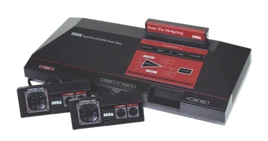


A Remarkable Port of a Fighting Legend
When players talk about unlikely technical achievements on Sega’s 8-bit hardware, Street Fighter II (Brazil) (En) deserves a place in the conversation. Released exclusively for the Brazilian market by Tec Toy during the mid-1990s, this adaptation brought one of the most influential fighting games ever made to the Master System Mark III family at a time when most gamers associated Street Fighter II with powerful arcade boards and 16-bit consoles.
Originally created by Capcom and first released in arcades in 1991, Street Fighter II revolutionized competitive gaming. Its roster of international fighters, combo-based combat, and distinctive special moves established the blueprint for modern fighting games. Seeing that experience translated onto Sega's aging 8-bit hardware seemed nearly impossible, yet Tec Toy managed to create a version tailored specifically for Brazilian Master System owners.
The result was more than a simple novelty. It became one of the most fascinating examples of regional game development and hardware optimization in gaming history.
Street Fighter II (Brazil) (En): An 8-Bit Miracle
By the time this version arrived, the Master System had largely faded from store shelves in North America, Europe, and Japan. Brazil, however, was a different story. Thanks to Tec Toy's partnership with Sega, the platform remained incredibly popular throughout the 1990s.
Recognizing the demand for modern fighting games, Tec Toy developed an exclusive adaptation of Street Fighter II. Rather than attempting a direct arcade conversion, the developers redesigned many systems around the Master System's limitations while preserving the essence of Capcom's masterpiece.
The game features recognizable versions of iconic fighters including Ryu, Ken, Chun-Li, Guile, Blanka, and others. Character sprites are smaller, animation frames are reduced, and stages are simplified, but the core identity of each fighter remains surprisingly intact.
Why It Was Important
- Brought a contemporary fighting game to an aging 8-bit console.
- Demonstrated Tec Toy's development capabilities.
- Extended the commercial lifespan of the Master System in Brazil.
- Provided local players with an affordable alternative to 16-bit hardware.
Mastering the Fight: Gameplay and Mechanics
The biggest challenge facing the developers was adapting a six-button arcade game to the Master System's two-button controller. Tec Toy solved this problem through context-sensitive controls and button combinations.
While not as precise as the arcade original, the system allows players to execute familiar techniques such as Hadoukens, Shoryukens, and Sonic Booms. Timing windows are adjusted to compensate for the hardware and controller limitations.
Matches remain one-on-one affairs where spacing, reactions, and special move execution determine victory. Character balance differs from the arcade version, partly due to technical restrictions and partly because of redesigned move properties.
The AI can be surprisingly aggressive. Some opponents react instantly to unsafe attacks, forcing players to learn spacing and defensive tactics. This gives the game a difficulty curve similar to many classic arcade-inspired titles of the era.
Despite reduced animation, fighters maintain distinct playstyles. Guile excels at zoning, Chun-Li remains quick and mobile, while Zangief specializes in close-range pressure.
Pushing the Master System Hardware to Its Limits
The Master System was never designed to run arcade-quality fighting games. Its limited memory, processor speed, and sprite capabilities presented enormous challenges.
To make the game possible, developers relied on clever compromises:
- Reduced sprite sizes to conserve memory.
- Fewer animation frames per character.
- Simplified stage backgrounds.
- Optimized collision detection routines.
- Compressed sound and music data.
Even with these reductions, the game remains visually impressive for an 8-bit fighter. Character portraits are recognizable, special attacks feature convincing visual effects, and arenas capture the atmosphere of their arcade counterparts.
Players may occasionally notice sprite flickering during intense exchanges, especially when projectiles and characters overlap. This was a common limitation of 8-bit hardware and is part of the authentic experience.
The soundtrack also deserves praise. While lacking the richness of arcade audio hardware, the PSG sound chip reproduces simplified versions of several famous Street Fighter themes that remain instantly recognizable.
Playing Today Through Emulation
Modern emulation has made preserving and enjoying Street Fighter II (Brazil) (En) easier than ever. Several Master System emulators provide highly accurate compatibility and excellent performance.
Recommended Emulators
- Genesis Plus GX – Excellent accuracy and broad platform support.
- Mesen – Highly accurate Master System emulation.
- RetroArch with Genesis Plus GX core – Ideal for advanced customization.
- Ares – Strong preservation-focused emulation.
Recommended Settings
- Enable integer scaling for pixel-perfect visuals.
- Use low-latency mode to minimize input lag.
- Activate save states for difficult CPU battles.
- Enable CRT shaders for authentic presentation.
- Use run-ahead settings cautiously to improve responsiveness.
When upscaled to 4K, the game's colorful pixel art remains surprisingly attractive. Sharp scaling highlights sprite details, while CRT filters can recreate the appearance of a 1990s television. On handheld devices such as the Steam Deck and Odin series, the game runs flawlessly and offers an excellent portable fighting experience.
If visual glitches occur, ensure the ROM region settings are configured correctly and use an updated emulator core. Most modern emulators handle the Brazilian release without special configuration.
The Legacy of an Unusual Fighting Game
Street Fighter II's influence on gaming is undeniable, but the Brazilian Master System adaptation occupies a unique niche within that history. It represents a rare example of regional development responding directly to local market demand.
Collectors and preservation enthusiasts frequently cite it as one of the most fascinating Master System exclusives ever released. It also serves as a reminder that gaming history extends beyond major markets and flagship platforms.
Today, retro gamers continue to revisit this version out of curiosity, nostalgia, and admiration for the engineering effort involved. While it cannot match the arcade original, it remains an impressive technical accomplishment that showcases how creative developers can overcome seemingly impossible hardware limitations.
FAQ
Is Street Fighter II (Brazil) (En) an official release?
Yes. It was produced for the Brazilian market through Tec Toy, Sega's long-time partner in Brazil, making it an officially licensed regional adaptation.
Does Street Fighter II (Brazil) (En) support all original fighters?
Most of the iconic roster appears, although certain gameplay elements, animations, and mechanics were simplified to fit within Master System hardware limitations.
How do I fix slowdown or graphical glitches in Street Fighter II (Brazil) (En)?
Use an accurate emulator such as Genesis Plus GX or Mesen, verify ROM integrity, and avoid outdated emulator builds. Most graphical issues are resolved with modern cores.
What is the best way to play Street Fighter II (Brazil) (En) today?
For the best experience, use RetroArch with the Genesis Plus GX core, enable integer scaling, apply a light CRT shader, and play with a modern controller featuring a responsive D-pad. This combination delivers excellent accuracy while preserving the feel of the original hardware.


